← Practice · October 5, 2026
Rebuilding a Website for Speed and SEO Without Losing Rankings
How we migrate heavy websites to static pages, preserve page URLs, and prepare content for search and AI answers.
8 min readwebsites

Rebuilding a website for speed and SEO starts with checking what is holding it back. If an old site built with a website builder or WordPress loads slowly, is awkward to use on a phone, and has poor search visibility, changing its appearance is not enough. At IKORG, we review the structure, preserve useful content, and move it to a fast technical foundation while accounting for the SEO results it has already achieved.
AI helps us do this work in a few days: prepare templates, write code, and process text. URLs, content, and indexing settings still need human review. Our task is to remove the causes of slow performance and preserve what already helps users find the pages. Below, we explain how this migration works, what we check before launch, and how we prepare content for AI search.
Why a Slow Website Gets in the Way of Users and Search
A website can be slow because of a heavy theme, plugins, large images, and third-party scripts. With a website builder, some of this overhead can be difficult to remove: it is tied to how the platform itself works. WordPress offers more flexibility, but old settings and accumulated extensions also need attention.
WordPress itself does not mean poor speed or weak SEO. Problems arise when the browser loads many components that visitors do not need just to display an ordinary service page. Someone wants to read the terms and find a phone number, but first has to wait for the page design to load.
This is especially noticeable on a phone. Text appears late, page elements shift, and a button does not respond immediately. Visitors may close the page before they even reach the offer. That is why we check not only how the home page loads, but also the path to a specific action: viewing a product, making a call, or submitting an inquiry.
Search engines also assess the quality of the page experience. For example, Google takes Core Web Vitals into account and recommends making pages easy to use on mobile devices. However, good speed metrics alone do not guarantee high rankings: the content must answer the query. This is reflected in Google's guidance on page experience.
We see speed improvements as a way to remove obstacles. If this work is postponed, the site keeps losing some visitors while they wait, and useful content remains behind an awkward interface.
What Changes After Moving to a Static Site
We build static websites with Astro and host them on Beget. Pages are converted into ready-made HTML in advance. When a visitor arrives, the server sends the prepared files: generating the page requires neither PHP nor database queries. This mode is supported in Astro.
The query “instantly loading website” captures the expected result well: someone opens a link and immediately starts reading. In practice, speed also depends on the connection, device, images, and connected services. That is why we work on everything that makes up the page.
| Aspect | Before, on WordPress | After, on a Static Site |
|---|---|---|
| Speed | Depends on the theme, plugins, database, and caching configuration | Ready-made HTML reduces the server's work when a page is opened |
| Security | The CMS, plugins, and access to the admin panel need attention | No public CMS or database; access credentials and external services still need protection |
| Updates | The core, theme, and plugins are updated; compatibility checks are needed | Pages are rebuilt when changes are made; build tools are also maintained |
| Hosting | Requires an environment that runs PHP and a database | Serving static files is enough to publish the site |
| Load | Without caching, requests can trigger server-side processing | The server sends documents prepared in advance |
To be clear: a well-configured WordPress site can also be fast, and a static page can be overloaded with video and scripts. We choose static sites where they fit the task: service websites, catalogs, and informational sections.
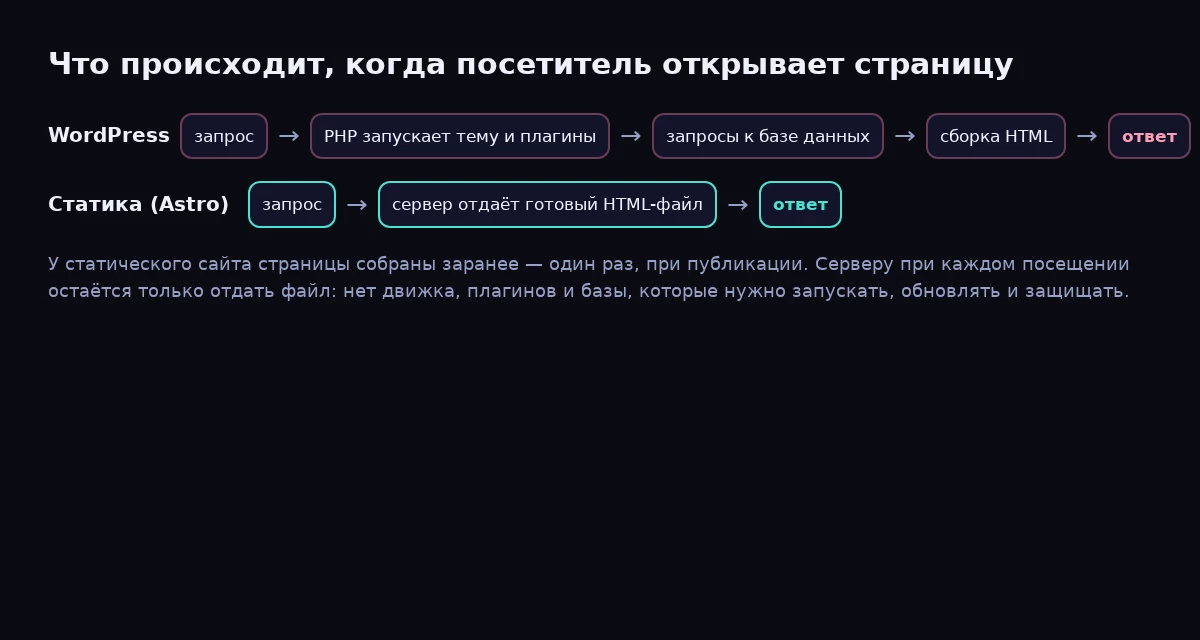
On WordPress, the page is assembled on every visit; on a static site, it is already prepared.
How AI Reduces the Work to a Few Days
In our work, Claude, GPT, and Gemini help write code and text, while GPT Image and Nano Banana help prepare graphics. A person defines the task, checks the facts, and makes decisions. This is especially important when rebuilding a live website: automatically rewritten text can lose essential terms of a service.
We start with the content and structure. We determine which pages will stay, where a new template is needed, and which elements repeat. Then we build the design and migrate the content. AI speeds up repetitive work, and we check the results on actual pages.
We build large sites from tables and data. Instead of manually laying out every item page, we prepare a template and rules for populating it. This lets us manage headings, specifications, and links consistently, and fix errors in the data source.
For example, we built the KUSHVATEKHPROM catalog in 1 day: 701 pages, loading in about 0.3 seconds. “IgraySrazu” took 4 days: 31,842 pages, loading in about 1.5 seconds. The exact timeline for your site depends on how many pages it has and how ready the content is.
The IKORG website gives an estimated completion time of 2–4 days. For a specific project, the timeline depends on content readiness, structure, and integrations. If user accounts, complex booking, or order processing are needed, we assess these features separately from the static pages.
Migrating a Website from WordPress: The MONIK Example
MONIK is monik.online, a website for crane trucks and tow trucks. We migrated it from WordPress to a static site in 1 day. The project has 46 pages, with a load time of about 1.0 seconds after migration.
An important detail of this migration was preserving the old image URLs. When changing platforms, it is easy to move photos to a new folder, rename files, and forget that the previous URLs were already used on the site and may have been known to search engines.
We preserved these URLs to reduce the risk of losing the images' accumulated visibility. Visitors barely notice this work: the photos continue to load. For the migration, it is essential, because a technical platform change should not unnecessarily change access to content.
This example shows why we consider the website as a whole. Migration affects pages, images, internal links, and metadata. A new appearance is only part of the task.

monik.online after migrating from WordPress to a static site: 46 pages, loading in about a second.
How We Reduce the Risk of Losing Rankings
The most straightforward approach is to keep the existing domain and page URLs. Search crawlers then find the content where it was before. If a URL has to change, we set up a permanent 301 redirect to the corresponding new page.
The mapping needs to be precise. A visitor opening an old link to a specific service should land on that service. Redirecting every URL to the home page makes it harder to preserve the intent of those visits. Guidance on URLs, redirects, and updating the sitemap is available in Yandex Webmaster Help.
Before launch, we use this checklist:
- Save a copy of the website, a list of URLs, and baseline traffic metrics.
- Check that all required pages and content are accounted for.
- Keep the existing URLs or prepare mappings for 301 redirects.
- Transfer title tags, meta descriptions, and main page headings.
- Preserve useful text, images, and their URLs where possible.
- Check internal links, menus, forms, and mobile display.
- Check indexing rules and canonical URLs.
- Build an up-to-date sitemap.xml.
- Check the site in Yandex Webmaster and submit the sitemap.
- After launch, monitor crawling, errors, impressions, and clicks.
We also avoid replacing all the text and the structure at the same time unless necessary. The clearer the set of changes, the easier it is to understand the results and find the cause of a possible error.
A well-managed migration can preserve rankings, but we cannot promise there will be no fluctuations. Search engines need to process the changes. That is why the work continues after publication: we check page availability and how indexing responds.
Website Optimization for AI in Practice
AI search uses website content when preparing answers. In scenarios familiar from Yandex Neuro and in Alice's search answers, useful information needs to be discoverable and readable. Yandex describes source analysis and answer preparation with links in Search with Alice Help.
We begin preparing content with direct answers. A service page should explain exactly what the company does, where it operates, what terms apply, and how to get in touch. If the answer is buried among generic statements, it is harder for a person to find it and harder for the content to serve as a clear source.
Next, we organize the structure: meaningful subheadings, short paragraphs, lists of terms, specifications, and customer questions. Each section should explain its own topic. Repeating a keyword phrase in every paragraph does not help.
We add schema.org markup based on the page's content: information about an organization, service, product, or article. It must match the visible text. We use it to describe the data explicitly, without promising automatic inclusion in answers. Special markup for AI search is not a universal requirement; for example, this is explicitly explained in Google's documentation on AI features in search.
The technical side consists of fast pages without unnecessary JavaScript, main text accessible in HTML, and a sitemap file. A sitemap helps search crawlers discover URLs; its purpose is described in Yandex Help. To make content eligible for inclusion in ChatGPT search answers, we also check that OAI-SearchBot access is not blocked: this is described in OpenAI's crawler documentation.
Our practical conclusion: those who remove these obstacles now become sources for AI search answers sooner. Speed alone does not guarantee citations, but a slow, confusing website will almost certainly lose out to competitors' easy-to-use pages, and the gap will grow as more people search through AI.
Frequently Asked Questions
Can We Keep the Existing Design?
Yes. We can preserve the recognizable design and structure while replacing the technical foundation. At the same time, we check which elements hurt speed or usability on phones. Moving to a static site does not require a complete change in visual style.
Do We Need to Change the Domain?
No. A static website can use the existing domain and retain its page URLs. Changing platforms does not in itself require a new name. The fewer unnecessary changes made during migration, the easier it is to check their effects.
How Do We Update a Catalog Without WordPress?
We can build a catalog from a table or prepared data. After the information changes, the site is rebuilt and published. We choose the update process to fit the work: who edits the content, which fields change, and how often.
Is a High PageSpeed Score Enough for SEO?
No. PageSpeed helps assess the technical side of a page, but it does not replace useful content, a clear structure, and correct indexing. We check the entire user journey: can someone find an answer, review the offer, and contact the company?
Is It Worth Rebuilding a Website If It Already Generates Inquiries?
First, we look at what works well and where there are limitations. If the pages are fast, easy to use, and meet the business's needs, changing platforms is unnecessary. If loading gets in visitors' way and accumulated problems complicate maintenance, rebuilding becomes a justified step.
At IKORG, we use AI to complete work faster and keep a person responsible for reviewing the results. Moving to a static site lets us make a website lighter and prepare it for search without necessarily giving up existing URLs and content. The starting point should be an assessment of the current website: it will show what to preserve, what to fix, and which results to check after launch.
You can see what our fast websites look like in the portfolio on the home page. If you want to know what a rebuild would do for your particular website, send us the URL, and we will show you what to preserve and what to speed up.